
How to Plan an Accessible Trip to Italy
October 1, 2025Bologna Without Barriers: Your Accessible Italian Adventure
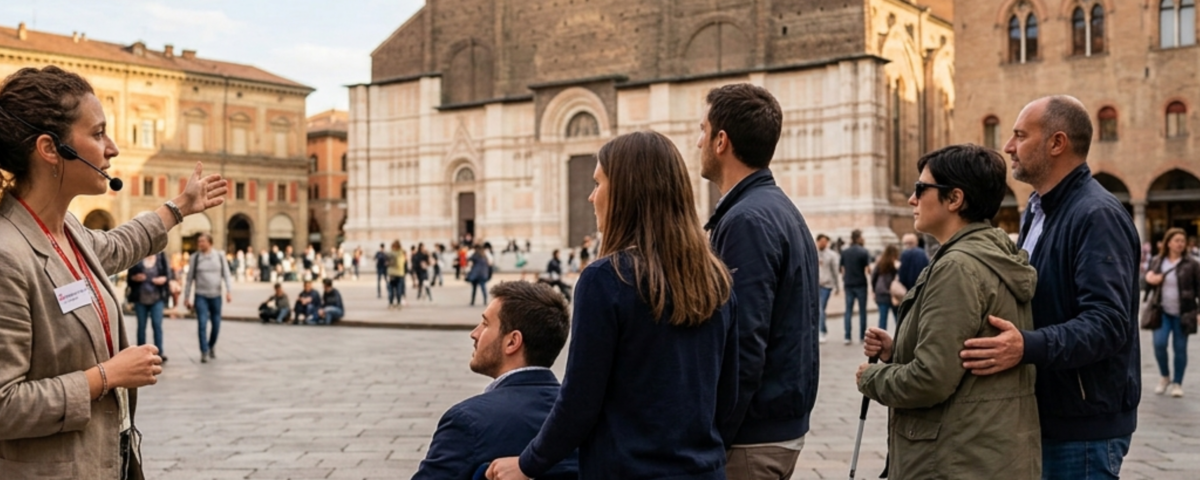
Bologna is considered to be one of the more accessible destinations in Italy and was nominated for the European Accessible City Award in 2021, making it a great city to visit for people looking for accessible travel. The city center is completely flat, which makes getting around the city much smoother. It’s often a city that gets lost in the mix of Venice, Rome, and/or Florence, but Bologna is a great place to really dive into Italian culture and has so many gems that get overlooked too often. It’s one of those places that once you get a taste, you’re dying to go back and experience it again.
Sites:
One of the many things the city is famous for are the porticoes, which were also named a UNESCO World Heritage Site in 2021. Porticoes are covered walkways that create a rhythm of columns, echoes, and shade that act as natural navigating tools. From a place to escape the hot sun/rain to a community hub, the porticoes are a cultural niche of the city that allows anyone to walk/roll as a local. Some of the famous porticoes in the city, like San Luca and Strada Maggiore, are absolutely stunning and worth a stroll underneath!
Besides the porticoes, there are plenty of museums and other sites in the city that let you glance into the city’s history and the traditions protected and practiced by the locals. Most museums offer guided tours and some offer audio guides, but keep reading for tips about how to get audio guides straight on your phone! Some other places definitely worth visiting include:
- Fountain of Neptune (Piazza Maggiore) – This breathtaking fountain in the middle of Piazza Maggiore was built in the 16th century. It’s a symbol of the power of the Pope who is said to have ruled the world like Neptune ruled the seas. Taking this statue in and the power it represents is a great way to understand how deeply rooted religion is in Italian culture and history. And although the fountain is stunning, another nice thing to do is to sit on the edge of the fountain and watch “the Italian way”. Listen to the beautiful language and the water behind you, feel the sun on your skin, and soak up Italian culture.
- Anteros Tactile Museum (Via Castiglione, 71) – This museum is a great option for people with visual impairments because it has a collection of three-dimensional bas-relief renditions of famous paintings from the Middle Ages to the modern era, particularly focusing on Renaissance paintings. The museum allows people to touch the renditions so they can visualize the paintings in their minds. Whether it’s a rendition of the Primavera or the Mona Lisa, you can let your hands and your mind do the work. It truly is an amazing experience that brings the arts to everyone. Here are some reviews from people who have visited the museum:
- Irene A: “Loretta Secchi is a wonderful guide, capable of transporting you to magnificent worlds. The tactile experience is difficult to describe, it must be experienced with curiosity and amazement.” Source: Google Reviews via Wanderlog
- Sara N: “I was really happy to have this experience at the tactile museum! It was a way to put yourself in the shoes of those who experience blindness and understand the teaching approach methods. I would like to bring my students too.” Source: Google Reviews via Wanderlog
- Museum of the City of Bologna (Via Castiglione, 10, Palazzo Pepoli) – Entering this museum is like going through a time machine; the art and artifacts date back centuries and finish in the present day. It’s an amazing way to understand the city’s journey throughout history and learn what elements have played integral parts in the culture. The 36 rooms of this museum take you through many different thematic areas, starting with the Painted City, The Tower of Time, Ancient Bologna, Historic Bologna, Bologna and the Arts, Contemporary Bologna, to Popular Bologna. The museum is very accessible; however, the first room may be a bit difficult for people with reduced mobility because there is a reconstructed Etruscan road that’s very uneven. The museum offers free entry for a disabled person and one companion if you email palazzopepoli@bolognawelcome.it or go directly to the museum ticket office. The museum’s ticket, which is €10, includes an audio guide that requires you to use your own smartphone and headphones.
Museum Of Modern Art Bologna (Via Don Minzoni, 14) – This museum tells the story of Italian art from the 1950s to today through curated exhibitions as well as a permanent collection. The permanent collection walks you through post-war Italian art movements, from political ideology to experimental performance art. You’ll see works by famous contemporary Italian artists like Maurizio Cattelan and international artists like Keith Haring. The museum is also home to an extraordinary collection dedicated to Giorgio Morandi from Bologna; he’s known for his breathtaking still-life paintings. The museum is mostly accessible. There are elevators to all floors, though certain elevators may take you to different floors, meaning you might have to return to the ground floor to go up again. Accessible bathrooms are available on each floor, and admission is free for visitors with disabilities and one companion. The museum also offers tactile tours for some of the artworks by reservation through the education department. To schedule a tactile tour, you can email them at mamboedu@comune.bologna.it.
Churches & Entrances:
Churches are not only a religious site in Italy, but a place where history is protected. Because of the country’s relation to the Catholic religion, a lot of the history is related/connected to the religion. Whether you are religious or not, the churches give you the chance to explore the history of a town or city you are visiting. Like museums, most churches offer audio guides that you do have to pay for (about 2€ – 5€).
- Cathedral of St. Peter (Via Dell’Indipendenza) – There are a ton of steps that lead to the main entrance, which for people with mobility issues, entering this church might seem impossible, but there is a way to enter; it’s just about finding it. If you go to the right of the main entrance toward Piazza del Nettuno, there’s a single door at street level. If you go through this door, turn left, go through another door, you’ll find yourself inside this beautiful church filled with depictions of historical events.
- Basilica of St. Petronius – This church may be a hassle to get into but it is definitely worth visiting to see the sundial at work (you will need an able-bodied companion for this journey). The accessible entrance is through the back of the church on Corte di Galuzzi 14. This street will have the windows of the Bank of Bologna (Banco di Bologna), and to your right you’ll find the number 14 next to a garage-looking door; this is the accessible entrance. But now you have to find someone to open this door, and this is where your able-bodied companion comes in. Your companion will go around to the main entrance and go to the souvenir/gift shop and ask someone who works there to open the accessible door on Corte di Galuzzi 14. Once they get the remote, you can enter, and to exit you will have to find the person with the remote to let you out. It’s a process but the church is absolutely stunning, and if you can make it for midday to see the sundial at work, the journey will be worth it.
- The Church of Santa Maria Della Vita – The main entrance is on Via Clavatura 10, which has stairs and a railing on either side of the stairs. However, the accessible entrance is on Via Clavatura 8. If you go through the gate and follow the sidewalk until you reach the door, go through that door and you’ll find yourself inside the church.
- Basilica of St. Francis – This is one of the more accessible churches in the historic city center. The main entrance, which is in Piazza San Francesco, has one step, making it not completely accessible, but there’s an accessible entrance from the back of the church in Piazza Malpighi. The interior is mainly flat and architecturally simple and linear for people with visual impairments to navigate.
- Sanctuary of the Madonna di San Luca – This church is located on top of a hill but can be reached by the San Luca Express train from the center of the city or by car with available parking. The San Luca Express train is a red and blue train that takes its passengers from Piazza Maggiore to the sanctuary and back. There is only one wheelchair space available on each train, so it’s recommended to call and reserve a seat on your desired journey. The ticket includes an audio guide in 10 different languages as well as assistance on board and on land. If you’re looking for a more private experience or have already booked private transportation, there is accessible parking near the entrance of the sanctuary. For visually impaired people, the inside is very spacious and easy to navigate. Religious staff are also frequently available to accompany people during their visit; you can contact them by emailing prenotazioni@santuariodisanluca.it or by calling +39 0512840436.
Restaurants:
One of the best things we recommend to do in Bologna is to eat. It is famous for mortadella, ragù, and many other classic Italian dishes. It’s also in the region of Parmigiano-Reggiano and balsamic vinegar – which make for great tours and tastings! If you decide to find a restaurant on your own, it’s important that you thoroughly check the accessibility of the restaurant beforehand. Unfortunately, only about a quarter of places in Italy are truly accessible to wheelchair users. This is due to steps at the entrance, availability of accessible bathrooms, and space to maneuver between tables in restaurants. Some delicious restaurants that we recommend with accessible access:
- L’Altro Spazio, Via Nazario Sauro 24/F: A restaurant designed without architectural barriers, with wide corridors for wheelchair access, a low accessible counter, menus in Braille, and attention to people with sensory disabilities. It is one of the few restaurants in Bologna designed explicitly for inclusion.
- 051 Osteria, Via Pescherie Vecchie – Quadrilatero: Easy access with street-level entrance, interior spaces large enough for wheelchairs, and staff willing to adapt tables. This is a modern restaurant near Piazza Maggiore. It is advisable to book and request an accessible table.
- Botanica Lab Cucina, Via Battibecco 4: Street-level entrance, spacious dining room with well-spaced tables; modern restaurant designed without barriers. Vegan restaurant in the historic center.
- DaZero Bologna Restaurant, Via Augusto Righi 30: Accessible entrance and spacious interior; listed among the restaurants in the city center with wheelchair access.
- Eataly Bologna Ambasciatori, Via degli Orefici 19: Building with ground-level entrance and internal lifts; bookshop, restaurant, and bistro fully accessible by wheelchair.
Transportation:
Now that we’ve convinced you to add Bologna on to your Italian adventure, let’s talk transportation. Getting to Bologna is quite easy depending on where you are coming from but it does involve planning. The easiest and cheapest way to get there is by train. Bologna train station is connected to all of the major cities in Italy, so depending on how far you are, you can make it a day trip or a few days! If traveling by train and you have disabilities or reduced mobility, it’s important to contact Sala Blu, because they will be your assistance for planning your trip, getting on and off of the train, and anything else you may need during your train journey. It’s important to contact them at least three hours before your trip, but the earlier the better, and save purchasing your ticket until after talking to them so that they can help you book everything properly.
As for transportation in and around the city, all of the buses in Bologna are equipped with a platform that’s perfect for people with wheelchairs to get on and off easily, and there’s a designated area on the bus for wheelchair users. For automated voice announcements, newer buses have automated announcements, whereas older buses may lack consistent audio. It may be best to use digital directions with audio features to know where you are and when to get off the bus.
As mentioned before, another way of getting around the city is by the San Luca Express, a small passenger train that offers tours of the city through three different routes. The red route, the green route, and the blue route give passengers an amazing tour of the city of Bologna by exploring the city center and farther outside on the red and green routes (including the Sanctuary of the Madonna di San Luca). However, there are some notable limitations with this mode of transportation. There is only space for one wheelchair on each train and it’s mainly for foldable wheelchairs, and it’s important to book your train journey in advance because of the limited availability. You can contact them by emailing amministrazione@cityredbus.com. On your journey, an accompanied person is required.
“Public” Bathrooms:
Knowing where bathrooms are while exploring a city is always a must, especially in places like Italy where you’ll be exploring for the entire day. There are technically public bathrooms in Italy, but the majority of the time you have to pay to use them. It’s typically under 2€, but you still have to pay, so they’re not all that public. Here are some “public” bathrooms around the city:
- Via IV Novembre Sala Borsa (Piazza del Nettuno, 3)
- Via Belvedere, 4B
- Via del Pratello, 80
- Parking Riva Reno (Via del Rondone)
- Parco dei Cedri
**Tip: When exploring the city, the BOforAll app is definitely worth checking out. It guides users through different inclusive paths to explore the city. It’s designed for people with visual, hearing, and motor disabilities to discover the cultural and artistic heritage of Bologna. It provides information, navigation, and guided tours to the university area and the area around Piazza Maggiore (Quadrilatero della Cultura). It includes:
- Inclusive content by describing points of interest using suitable language for different needs, facilitating understanding for people with sensory disabilities.
- It offers accessible routes to help navigate people to different monuments, museums, and churches with a particular focus on mobility needs.
- It provides useful information not only for disabled people, but also to facilitate visits for a wider audience.
- It was designed in collaboration with people with disabilities, ensuring it addresses real accessibility needs identified by the disabled community of Bologna.
Bologna is a beautiful city with so much history and a great place to visit for people in search of accessible travel adventures. From the porticoes to the delicious food, Bologna is a place that everyone should see at least once in their life, if not many times!
Want to take a trip to Bologna? We can help organize everything!
Want to take a trip to Bologna?
Let WanderAbility help you plan your accessible adventure!